
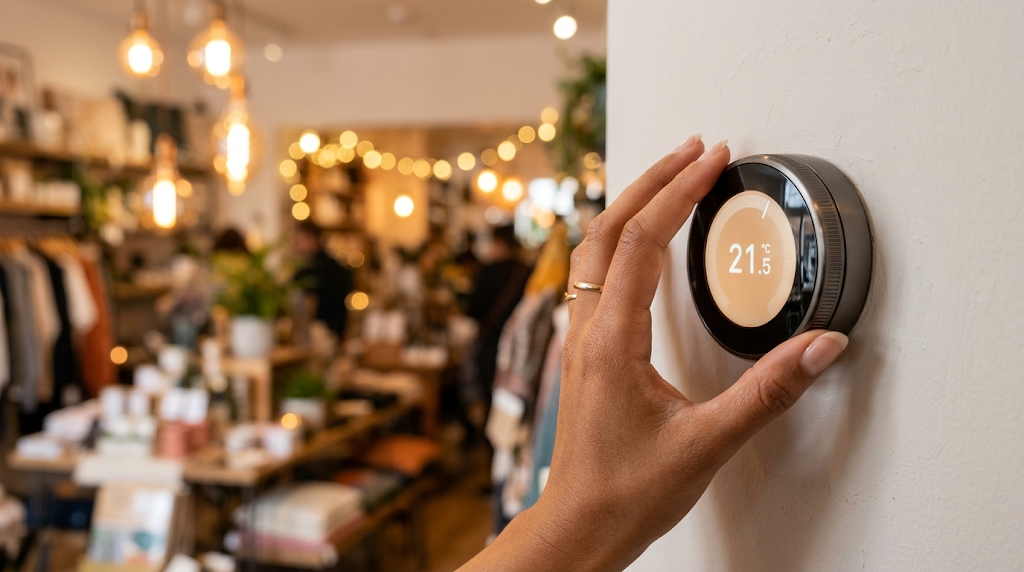
Heating is one of the biggest energy costs for most UK businesses. In offices, shops, salons, cafés and workshops, heating often runs to a simple timer that was set years ago, heats empty rooms, and keeps going on bank holidays.
A smart thermostat fixes much of that. This guide explains what a smart thermostat is, how it works, what it costs, how much a business can realistically save, and what to check before you buy one.
What is a smart thermostat?
A smart thermostat is a heating control that connects to the internet. It lets you set, change and monitor your heating from a phone, tablet or computer, wherever you are.
A standard thermostat simply switches the heating on when a room drops below a set temperature. A smart thermostat goes further. It can follow a detailed schedule, react to who is in the building, learn how long your premises take to warm up, adjust for the weather outside, and show you exactly how much the heating has been running.
For a business, that means the heating works around your opening hours rather than the other way round.
How does a smart thermostat work?
Most smart heating systems have three parts:
- The thermostat or room sensor. This sits on a wall, measures the temperature and lets staff see or adjust the setting.
- A receiver or relay. This is wired to your boiler, heat pump or heating controls and switches the heating on and off.
- A hub or app. The hub connects the system to your WiFi so you can control it through an app or a web dashboard.
When the room is colder than your target, the thermostat tells the receiver to fire the heating. Some systems also talk to the boiler directly using a protocol called OpenTherm. Instead of switching the boiler fully on or off, they ask it to run at a lower, steadier output. That is often more efficient, especially with condensing boilers.
What can a smart thermostat do for a business?

Here are the features that make the biggest difference in commercial premises:
- Remote control. Turn the heating off from home if the office is closed unexpectedly, or warm it up before an early meeting.
- Detailed schedules. Set different times for each day, including weekends, late opening and bank holidays.
- Zoning. Heat the reception, office and workshop to different temperatures and at different times, rather than heating the whole building to one setting.
- Occupancy and geofencing. Some systems use motion sensors or staff phones to detect when the building is empty and turn the heating down.
- Learning and preheating. The system learns how long your premises take to warm up and starts at the right moment, so the building is comfortable at opening time without heating it for hours beforehand.
- Weather compensation. It adjusts to the outdoor temperature so the boiler works less hard on milder days.
- Open window detection. It notices a sudden drop in temperature and pauses heating.
- Energy reports. You can see how many hours the heating ran each day and spot waste.
- Tamper lock. Many systems let you lock the wall unit or limit the range staff can change it to. This is very useful in shared offices and customer areas.
Smart thermostat vs programmable thermostat
A programmable thermostat lets you set times and temperatures, but it only does what you programmed into it. If the plan changes, someone has to be standing in front of it to change it.
| Feature | Programmable thermostat | Smart thermostat |
|---|---|---|
| Set heating times | Yes | Yes |
| Change settings remotely | No | Yes, from an app or browser |
| Separate zones | Rarely | Yes, with extra sensors or radiator valves |
| Learns your building | No | Many models do |
| Reacts to occupancy | No | Many models do |
| Usage reports | No | Yes |
| Lock settings from staff | Sometimes | Usually |
| Manage more than one site | No | Yes, on many business platforms |
If your premises have predictable hours and nobody touches the controls, a well set programmable thermostat already saves money. A smart thermostat earns its place when hours vary, when several people adjust the heating, or when you want to see and control things without being on site.
How much does a smart thermostat cost?
Prices vary with the brand and how many zones you need. As a rough guide in the UK:
- Single zone smart thermostat: around £100 to £250 for the kit
- Professional installation: around £60 to £150, depending on your wiring and location
- Smart radiator valves for zoning: around £40 to £70 per radiator, plus a hub if needed
- Commercial or building management controls: from several hundred pounds for small sites to thousands for larger buildings
Some business platforms also charge a monthly fee for advanced features such as multi site dashboards or detailed reports. Check this before you buy.
Can a smart thermostat save a business money?
Yes, when it is set up well. The savings come from three places: not heating empty buildings, not overheating occupied ones, and running the boiler more efficiently.
Temperature alone makes a big difference. The Carbon Trust estimates that turning the heating down by just 1°C can cut heating bills by up to 8%. A smart thermostat also makes it easy to stop heating the building overnight, at weekends and during closures, which is where many businesses waste the most.
A simple example
Here is an illustration for a small office. Your own numbers will differ.
- Annual gas use for heating: 30,000 kWh
- Gas unit rate: 7p per kWh
- Annual heating cost: about £2,100
If better scheduling and a slightly lower setpoint cut heating use by 10%, that saves around £210 a year. A smart thermostat costing £300 fitted would pay for itself in about 18 months. The saving grows with larger premises, longer opening hours, or poorly controlled heating to start with.
To see what you are paying per kWh right now, check our guide to business gas prices per kWh. Lower usage only pays off fully when your unit rate is competitive too.
Will a smart thermostat work with my heating system?
Most will, but check before you buy:
- Combi, system and regular gas boilers: compatible with almost all smart thermostats.
- Heat pumps: many smart thermostats work with heat pumps, but heat pumps run best with steady, low temperatures. Choose a model that supports your heat pump and avoid big daily temperature swings.
- Electric storage heaters and panel heaters: these usually need dedicated smart controllers or smart plugs rather than a standard boiler thermostat.
- Larger commercial systems: buildings with several boilers, air conditioning or a building management system need commercial controls. Speak to a heating engineer.
Look up your boiler or heat pump model on the thermostat maker’s compatibility checker before ordering.
Can I install a smart thermostat myself?
Some simple kits replace a battery thermostat and can be fitted by a confident person. However, most installations involve wiring a receiver into the heating controls, which means working with mains electricity.
For a business, we recommend using a qualified heating engineer or electrician. Work on the gas boiler itself must be carried out by a Gas Safe registered engineer. A professional install also makes sure the system is set up properly, which is where most of the savings come from.
What happens if the WiFi goes down?
Your heating does not stop. Most smart thermostats keep running your last schedule locally, and you can still change the temperature on the wall unit. You lose remote control and reports until the connection comes back.
Is a smart thermostat secure?
Any device connected to your business network needs basic protection:
- Change any default passwords and use a strong, unique password for the app account
- Turn on two factor login if the app offers it
- Keep the thermostat on your staff network, not the guest WiFi
- Install firmware updates when they are released
- Limit admin access to the people who actually manage the heating
Smart thermostat vs smart meter
They are often confused but do different jobs. A smart meter measures how much gas or electricity you use and sends readings to your supplier. A smart thermostat controls your heating. They work well together: the smart meter shows the effect of the changes you make with the thermostat.
Are there grants or tax reliefs for smart thermostats?
There is no single national grant for business smart thermostats right now, but some local councils and regional energy schemes offer funding for energy efficiency upgrades. Check your local authority’s business support pages.
For tax, heating controls bought by a business are often treated as plant and machinery and may qualify for capital allowances such as the Annual Investment Allowance. Rules depend on your business, so confirm with your accountant before you buy.
How to get the most from a smart thermostat
- Match the schedule to real opening hours, including cleaners, deliveries and staff who arrive early.
- Set sensible temperatures. Around 19°C to 21°C suits most offices. Storage areas and warehouses can often be lower.
- Use zoning so rooms that are rarely used are not heated like the main office.
- Lock the controls so they cannot be turned up to 28°C and left there.
- Check the weekly report for heating that runs when the building is closed.
- Service your boiler every year so it runs efficiently.
- Review your energy contract. Cutting usage helps most when you are also paying a fair rate.
For more ideas, read our guide on how to reduce business energy consumption.
Cut usage and cut your rate
A smart thermostat lowers how much gas you use. The other half of the bill is the price you pay per unit and your standing charge. If your contract has rolled over or you are not sure your rate is competitive, Utility Market Watch can compare prices from a wide panel of UK suppliers for you.
Get a free business energy quote or book a free energy health check and we will review your current contract.
Frequently asked questions
What is a smart thermostat in simple terms?
It is a heating control that connects to the internet, so you can set and change your heating from your phone or computer. Many also learn your patterns and adjust the heating automatically to save energy.
Is a smart thermostat worth it for a small business?
For most small businesses with gas central heating, yes. If your opening hours vary, several people touch the controls, or the building is often empty, a smart thermostat usually pays for itself within one to three years.
How much can a smart thermostat save?
It depends on how well your heating is controlled today. Businesses that currently heat empty premises or overheat rooms tend to save the most. Even lowering the temperature by 1°C can cut heating costs by up to 8%.
Do smart thermostats need WiFi?
They need WiFi for remote control, app access and reports. Without WiFi, most will keep running your schedule and can be adjusted at the wall unit.
Can one app control heating across several sites?
Yes. Many business focused systems let you manage several buildings from one dashboard, with separate schedules and access for each site.
Does a smart thermostat work with a heat pump?
Many do, but not all. Check the maker’s compatibility list and choose a model that supports steady, low temperature heating.
Do I need an engineer to fit a smart thermostat?
For most business installations, yes. Wiring into heating controls should be done by a qualified heating engineer or electrician, and any work on a gas boiler must be done by a Gas Safe registered engineer.
What is the difference between a smart thermostat and a smart meter?
A smart meter records how much energy you use and sends readings to your supplier. A smart thermostat controls your heating. Used together, they help you see and cut your heating costs.