
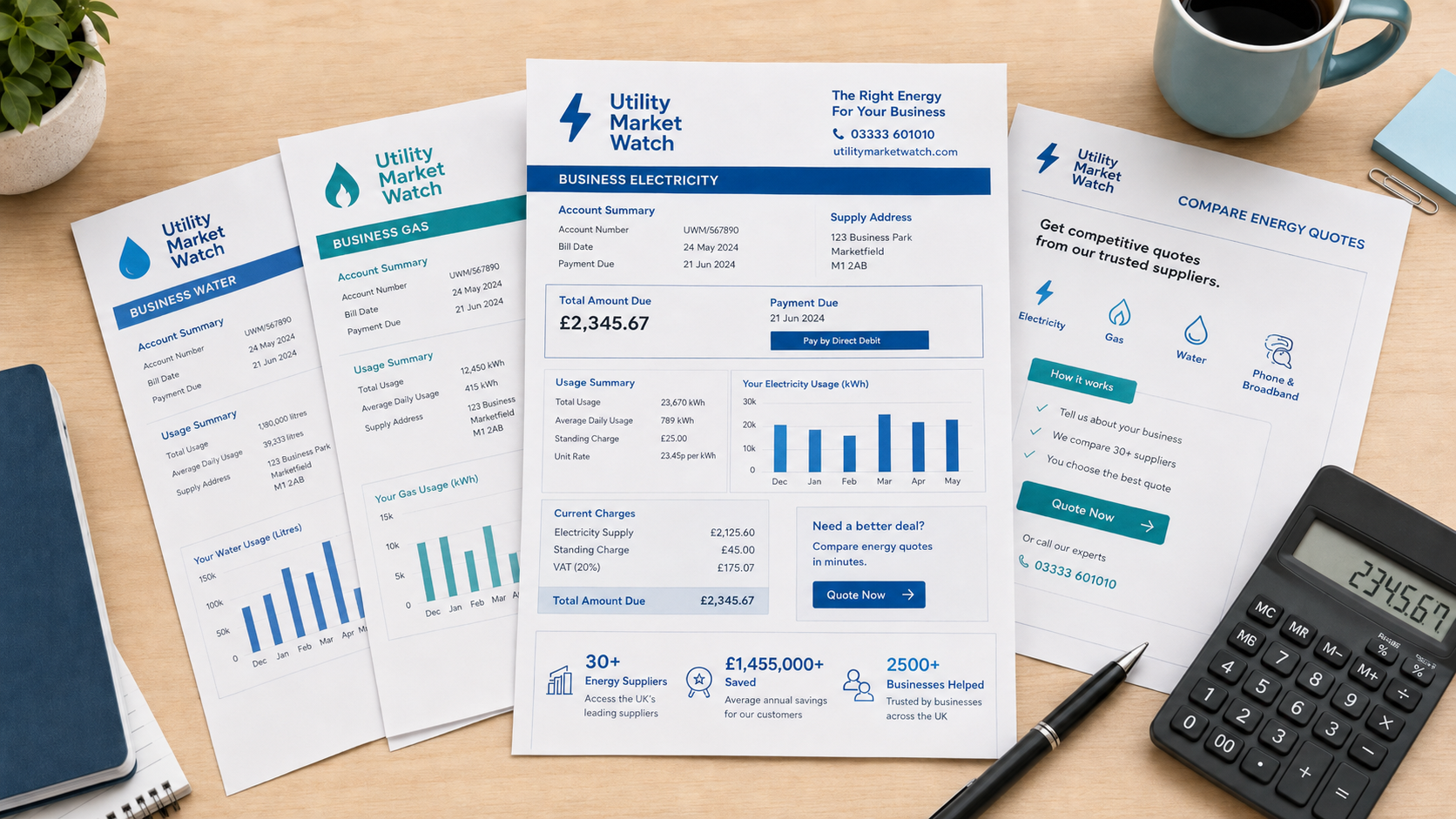
A utility bill is a statement showing how much you need to pay for an essential service supplied to your home or business, such as electricity, gas or water.
For businesses, utility bills are an important part of everyday running costs. Understanding what counts as a utility, what appears on your bill and how your charges are calculated can make it easier to keep track of spending and spot unexpected changes.
So, what is classed as a utility bill in the UK? Here is what you need to know.
So, What Is a Utility Bill?
A utility is a service used to keep a home or business running. The main utilities in the UK are electricity, gas and water.
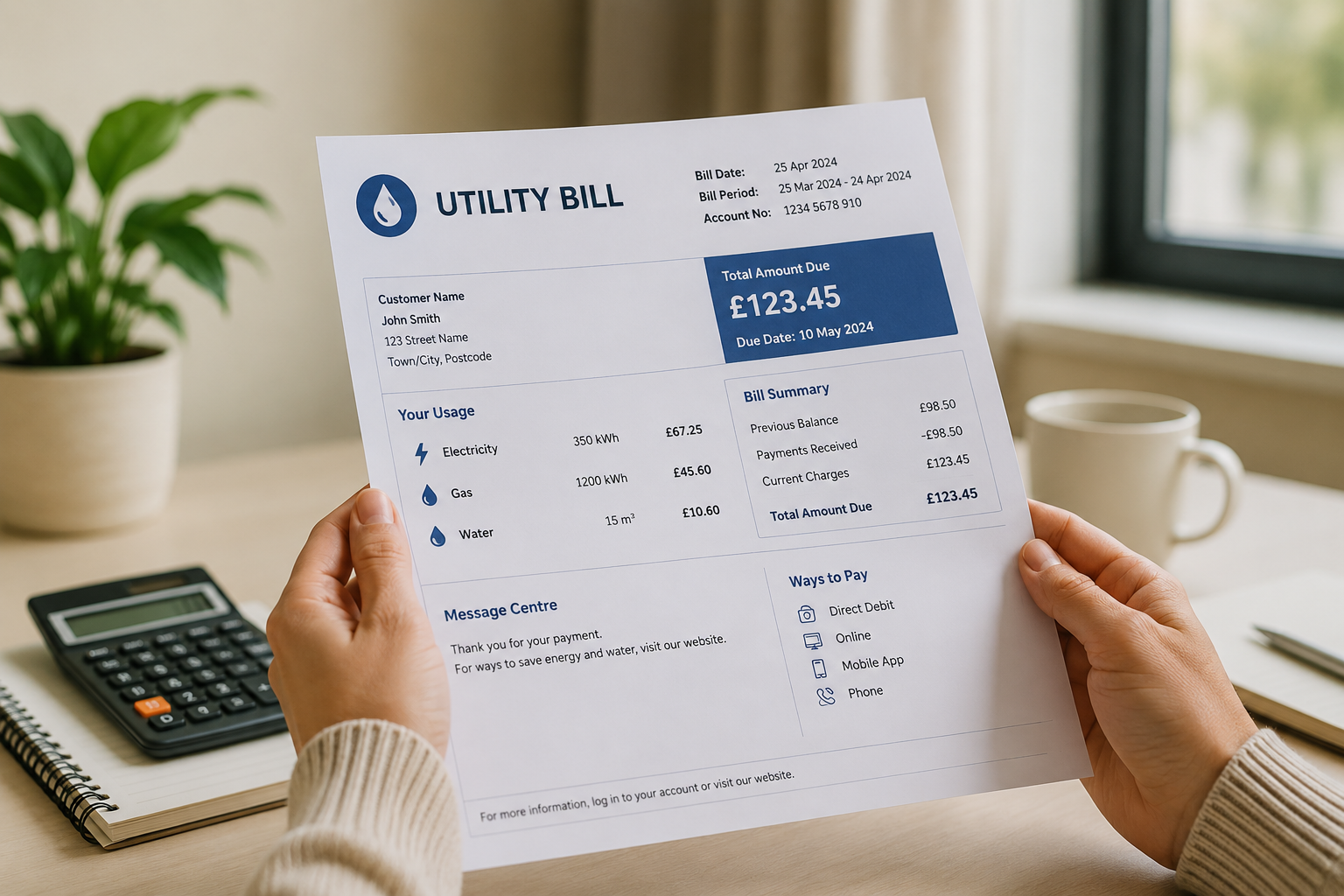
A utility bill is the statement or invoice sent by the company providing that service. It normally shows how much you have used, what you have been charged and whether there is a balance to pay.
Businesses and households receive many of the same types of utility bills, although commercial accounts can be more complicated because businesses may use more energy, have multiple meters or operate from several premises.
What Counts as a Utility Bill?
The clearest examples of utility bills are:
- Electricity bills – cover electricity supplied to your property.
- Gas bills – cover gas used for heating, hot water, cooking or business processes.
- Water bills – cover water supply and may also include wastewater charges.
- Broadband bills – often treated as a modern utility because internet access is essential to many homes and businesses.
- Landline phone bills – commonly grouped with utility bills.
- Mobile phone bills – may be accepted in some situations, but not all organisations treat them in the same way.
Electricity, gas and water are the three main utility bills most people think of. Other services can depend on the context.
Electricity Bills
An electricity bill shows how much electricity has been supplied to your premises and how much you need to pay.
It will usually include your electricity usage in kilowatt-hours (kWh), your unit rate, standing charge, meter information and account balance.
For businesses, electricity use can vary considerably. A small office may have relatively modest demand, while a restaurant, care home, warehouse or manufacturer may use much more.
If you run a business, reviewing your business electricity contract as well as your consumption can help you understand what is driving your costs.
Gas Bills
A gas bill covers the gas supplied to your property.
Gas is commonly used for heating, hot water and cooking, while some businesses also use it as part of their day-to-day operations or production processes.
Your bill will normally show your consumption, meter readings, rates, standing charges and total amount due.
Businesses approaching the end of a contract may want to review available business gas options before agreeing a new deal.
Water Bills
Water is another core utility.
A water bill covers the water supplied to your premises and can also include wastewater or sewerage charges.
The amount you pay can depend on whether the property is metered, how much water is used and the charging arrangement that applies.
For businesses with significant water use, regularly reviewing usage and business water costs can be particularly useful.
Is Council Tax a Utility Bill?
No. Council Tax is not a utility bill.
Council Tax is a local tax paid by households to help fund services provided by the local authority. It is different from paying a supplier for electricity, gas or water.
For commercial properties, businesses may have to pay business rates instead. Business rates are also not utility bills.
The confusion often comes from the fact that Council Tax documents can be accepted as proof of address in some situations.
Is a Phone Bill a Utility Bill?
A landline phone bill is commonly treated as a utility bill.
Mobile phone bills are less straightforward.
Depending on why you have been asked for a utility bill, a mobile statement may or may not be accepted. For example, some UK government processes list mobile phone bills as acceptable address evidence, while others specifically refer to landline bills or other utility documents.
If the bill is needed for an official check, always follow the requirements of the organisation asking for it.
Is Broadband a Utility Bill?
Broadband is often considered a modern utility, particularly because internet access has become essential for many businesses.
Companies rely on broadband for everyday tasks such as:
- Sending emails
- Taking online payments
- Using cloud-based software
- Managing bookings
- Speaking with customers
- Video conferencing
- Ordering stock
However, whether a broadband bill is accepted as an official utility bill can depend on the organisation requesting it.
Is a TV Licence a Utility Bill?
A TV Licence is not normally considered a core utility bill in the same way as electricity, gas or water.
It is a licence rather than a charge based on the supply or consumption of a utility.
Businesses may still require a TV Licence where the relevant viewing rules apply, but the cost should be treated separately from normal energy and water bills.
What Is Not Considered a Utility Bill?
It is easy to confuse other regular expenses with utilities.
The following are not normally utility bills:
- Council Tax
- Business rates
- Rent
- Mortgage payments
- Home or business insurance
- Bank statements
- Credit card statements
Some of these documents may still be accepted as proof of address, but that does not make them utility bills.
Can a Utility Bill Be Used as Proof of Address?
Yes. Utility bills are commonly used as proof of address in the UK.
A suitable bill will usually show details such as:
- Your name
- Your current address
- The provider’s name
- The date the bill was issued
However, there is no single list of documents accepted by every organisation.
Some organisations may request a recent gas, electricity, water or landline bill. Others may accept broadband or mobile phone statements as well.
The age of the document can also matter. For example, some checks ask for a utility bill issued within the previous three months.
Always check the exact requirements before submitting a bill as proof of address.
What Information Is on a Utility Bill?
Although every supplier uses a different layout, most utility bills contain similar information.
You can usually expect to see:
- Account holder’s name
- Account number
- Supply or service address
- Billing period
- Meter readings where relevant
- Energy or water usage
- Unit rate
- Standing charge where applicable
- Payments already made
- Current balance
- Amount due
For a business, checking these details regularly can help identify unusual consumption or unexpected charges rather than simply paying the total at the bottom of the bill.
How Much Are Utility Bills in the UK?
There is no single average utility bill that applies to every household or business.
How much you pay can depend on factors such as:
- Property size
- Location
- Energy consumption
- Number of people using the premises
- Opening hours
- Equipment and machinery
- Supplier and contract
- Time of year
For businesses, comparing your bill with a general UK average may not be very useful. A small office and a large restaurant can have completely different energy requirements.
It is usually more useful to look at your own consumption, current rates and contract terms.
How Can Businesses Reduce Utility Bills?
There are two main areas to consider: how much you use and what you pay.
Businesses can start by reducing unnecessary consumption. Switching off unused equipment, improving heating controls, fixing water leaks and monitoring unusual changes in usage can all help.
It is also worth reviewing your electricity, gas and water contracts when the time is right.
If your current contract is approaching renewal, Utility Market Watch can help you compare business utility quotes from its supplier panel and review options suited to your business.
Final Thoughts
So, what is a utility bill?
In simple terms, it is a bill for a service used to keep your home or business running. Electricity, gas and water are the clearest examples in the UK, while broadband and telephone services may also be treated as utilities depending on the situation.
Council Tax, rent, mortgages and insurance are not utility bills, even though some of these documents can still be used as proof of address.
For businesses, understanding your utility bills can also make it easier to monitor consumption, spot unusual charges and make better decisions when your contracts are due for renewal.