
Last updated: 16 October 2026
An MPAN number is the unique reference for an electricity supply point, and an MPRN number does the same job for gas. Every business site has one of each fuel it uses, and suppliers and brokers need them to price a contract and process a switch. This guide explains what each number is, where to find it on a business bill or meter, how to read an MPAN, and what to do if you have lost your bills.
What is an MPAN number?
An MPAN (Meter Point Administration Number) identifies a single electricity supply point. The Energy Networks Association describes it as a unique ID for your electricity supply, a bit like an address that tells energy companies where to send bills and how to track usage.
The number belongs to the supply point, not to you or your supplier. It stays with the premises when you change supplier or when a new tenant moves in, which is why it is the first thing a supplier asks for. SmartestEnergy lists the MPAN as a core term in its energy glossary, alongside related terms such as half hourly meters, loss factors and distribution network operators.
What is an MPRN number?
An MPRN (Meter Point Reference Number) is the gas equivalent. Cadent, which runs gas networks in several regions, says it is the number used to identify the gas service at your property.
Unlike the MPAN, the MPRN is a single reference with no supplementary top line. It is managed through the gas industry’s central data service rather than by your regional electricity network.
What is the difference between an MPAN and an MPRN?
The short answer is fuel type: MPAN for electricity, MPRN for gas. Energy UK sets out the split clearly, with the MPAN identifying your electricity meter and supply and the MPRN identifying your gas meter and supply.
| MPAN | MPRN | |
|---|---|---|
| Fuel | Electricity | Gas |
| Full name | Meter Point Administration Number | Meter Point Reference Number |
| Layout on a bill | Two lines, often in a grid marked with a large “S” | A single number |
| Who can tell you the number | Your distribution network operator (DNO) | The gas Meter Point Administration Service, via Find My Supplier |
| Source | ENA, Energy UK | Xoserve, Energy UK |
If your business uses both fuels at one site, you will have one of each. A site with several electricity meters or supplies can have more than one MPAN.
Where can you find an MPAN on a business electricity bill?
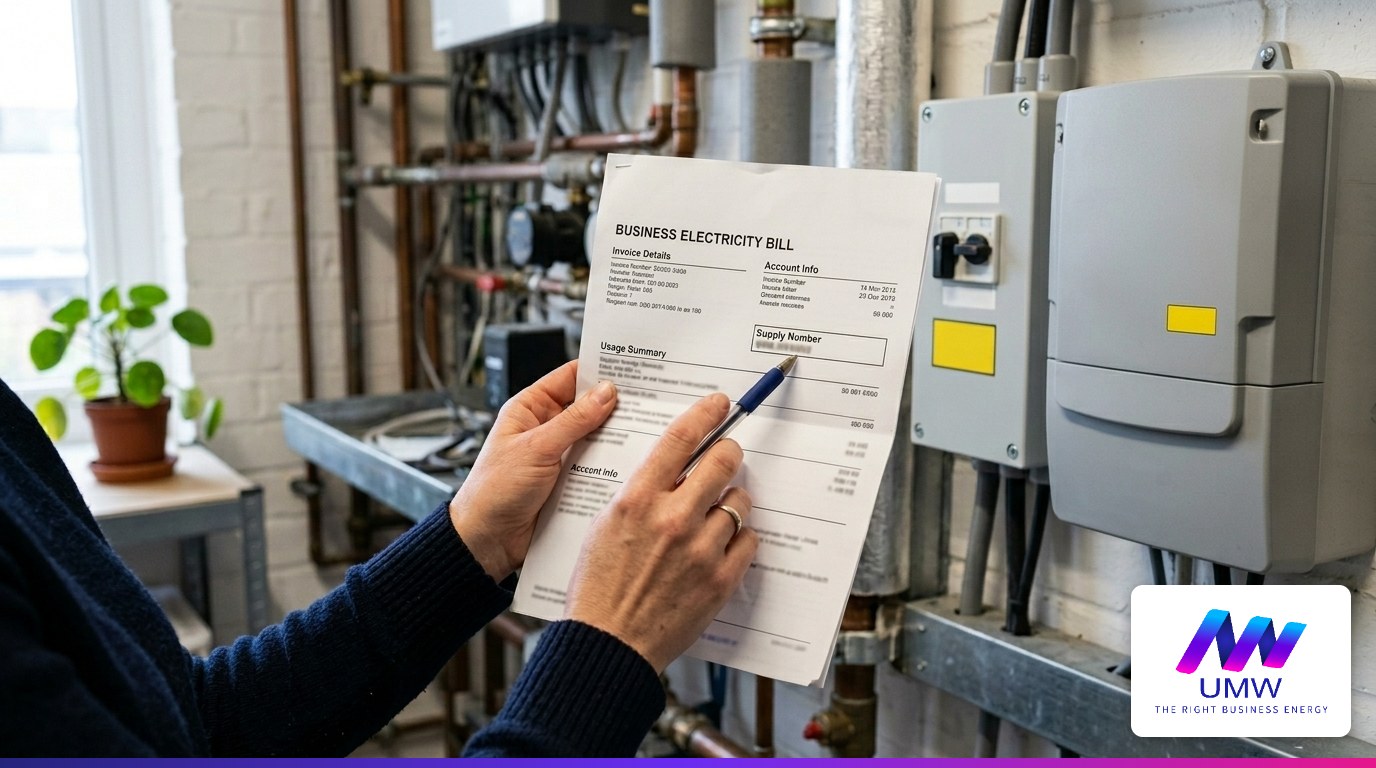
Look for a box of numbers on your bill, usually on the first or second page. UK Power Networks says to look for a grid of numbers with a large letter “S” beside it, and that the MPAN itself is the bottom row.
Some suppliers print the bottom row only, often labelled “supply number”, “MPAN” or “meter point”. If you have several sites on one bill, each site should have its own supply number in the site summary. Our guide to what a utility bill includes shows where the other key details sit.
Where can you find an MPRN on a business gas bill?
On a gas bill, the MPRN is usually printed near the meter details, labelled “MPRN”, “meter point reference” or “M number”. Cadent refers to the M Number helpline, so you may see that wording too.
It is not the same as your meter serial number, which is printed on the meter itself. Suppliers can usually work with either, but the MPRN is the reference that identifies the supply point for a switch.
How do you read an MPAN?
An MPAN has two parts: a top line of supplementary data and a bottom line called the core. The core identifies the supply point permanently, while the top line describes how the supply is charged and settled.
The bottom line (core MPAN)
SSEN describes the core as a unique 13 digit reference that identifies each electricity supply point in Great Britain. It breaks down into three pieces:
- Distributor ID (first 2 digits): tells you which distribution area the site is in. SSEN says it informs you which Distribution Service Area you belong to.
- Unique identifier (next 10 digits): the reference for your specific supply point within that area.
- Check digit (last digit): SSEN says it validates the previous 12 digits, so a mistyped MPAN is usually caught.
The top line (supplementary data)
The top line traditionally showed three items. SSEN describes each one in its MPAN guide:
- Profile class: the pattern of usage the supplier is registered against.
- Meter time switch code (MTC): the switching times for meters on multi rate tariffs such as Economy 7.
- Line loss factor class (LLFC): used to calculate the charge to your supplier for using the electricity network.
This top line has recently changed. Under industry change R0083, Ofgem approved keeping the existing two line structure of the Supply Number while replacing the MTC with a Standard Settlement Configuration (SSC) ID and the line loss factor class with a DUoS tariff ID. The bottom line stays the same.
SmartestEnergy notes that MPAN topline formatting was updated on customer bills from September 2025 as part of the move to market wide half hourly settlement. So if your newer bills show different top line codes from older ones, that is expected.
What do the profile classes mean?
The profile class, the first two digits of the top line, groups non half hourly sites by usage pattern. Elexon, which runs electricity settlement, lists eight profile classes:
| Profile class | Description |
|---|---|
| 01 | Domestic unrestricted |
| 02 | Domestic Economy 7 |
| 03 | Non-domestic unrestricted |
| 04 | Non-domestic Economy 7 |
| 05 | Non-domestic maximum demand, peak load factor less than 20% |
| 06 | Non-domestic maximum demand, peak load factor 20% to 30% |
| 07 | Non-domestic maximum demand, peak load factor 30% to 40% |
| 08 | Non-domestic maximum demand, peak load factor over 40% |
Source: Elexon
Business sites on standard single rate or Economy 7 style meters fall under 03 or 04. Classes 05 to 08 apply to larger sites with maximum demand metering.
What does profile class 00 mean?
A profile class of 00 means the supply has no profile class, which is the case for half hourly settled sites. The R0083 decision says the field is populated with “00” for any MPAN without a profile class.
NGP describes half hourly metering as a meter that records usage every 30 minutes and sends that data to the industry, and says most larger commercial and industrial sites fall into this category. Half hourly sites are priced differently from standard meters, and we will cover them in a separate guide.
Which region does my MPAN distributor ID belong to?
The first two digits of the core MPAN tell you your distribution network operator (DNO). The Energy Networks Association publishes the full distributor ID list; the 14 regional IDs are below.
| Distributor ID | Region | Network operator |
|---|---|---|
| 10 | Eastern England | UK Power Networks |
| 11 | East Midlands | National Grid Electricity Distribution |
| 12 | London | UK Power Networks |
| 13 | Cheshire, Merseyside and North Wales | SP Energy Networks |
| 14 | West Midlands | National Grid Electricity Distribution |
| 15 | North East England | Northern Powergrid |
| 16 | North West England | Electricity North West |
| 17 | North Scotland | Scottish and Southern Electricity Networks |
| 18 | South Scotland | SP Energy Networks |
| 19 | South East England | UK Power Networks |
| 20 | Southern England | Scottish and Southern Electricity Networks |
| 21 | South Wales | National Grid Electricity Distribution |
| 22 | South West England | National Grid Electricity Distribution |
| 23 | Yorkshire | Northern Powergrid |
Source: Energy Networks Association
IDs from 24 upwards belong to independent distribution network operators (IDNOs), which often serve newer business parks and developments. The ENA list includes these too.
Your distributor ID matters for price. SmartestEnergy explains that there are 14 distribution networks covering the UK (excluding Northern Ireland), and distribution charges are one of the non-commodity costs built into your rate.
How do you find your MPAN or MPRN if you have lost your bill?
You can still get both numbers without a bill. The routes are different for electricity and gas.
Electricity
Contact your distribution network operator. Energy UK says your DNO can provide your MPAN, and the DNO should also be able to tell you who your current supplier is.
If you do not know your DNO, the Energy Networks Association postcode tool will find it. Some DNOs, such as UK Power Networks, also offer an online MPAN lookup for bill payers.
Gas
Use the Find My Supplier service run by Xoserve. Xoserve says you can use its Find My Supplier service to find out who supplies your gas, and Cadent confirms you can enter your postcode to look up your MPRN.
You can also phone 0870 608 1524. Xoserve lists this number and says calls cost 7p per minute plus your phone provider’s charges.
Why does a broker need your MPAN and MPRN?
Your supply numbers let a broker or supplier identify exactly which site they are pricing. The distributor ID and top line codes affect network charges, so a quote without the right MPAN is only an estimate.
The numbers also tell a supplier what meter you have and how the site is settled. A half hourly site and a profile class 03 site can use similar amounts of energy but be priced on very different terms.
When you switch, the new supplier registers the supply point using the MPAN or MPRN. A wrong digit can delay the switch or, in rare cases, register the wrong site, so it pays to check them against a recent bill. Our guide to switching business energy supplier walks through the full process.
Timing matters too. SEFE Energy warns that out of contract rates are typically considerably higher than contracted prices, so having your supply numbers ready before your end date gives you more time to compare. See our business energy contract renewal guide for when to start.
What else should you have ready for a quote?
Alongside your MPAN and MPRN, a broker will usually ask for:
- Your current supplier and contract end date
- Annual usage in kWh for each meter, or a recent bill showing it
- The business’s registered name and address
- Any notice of renewal or termination letters you have received
For electricity sites, our business electricity page explains what we compare. For gas, see business gas.
Frequently asked questions
How many digits is an MPAN number?
The core MPAN on the bottom line is 13 digits, according to SSEN. The full supply number also includes a top line of supplementary data, which is printed above it.
Does my MPAN change when I switch supplier?
No. The MPAN belongs to the supply point, so it stays the same when you change supplier or when the premises changes hands. The top line codes can change if the meter or settlement arrangement changes.
Is the MPAN the same as the meter serial number?
No. The MPAN identifies the supply point, while the meter serial number identifies the physical meter. If the meter is replaced, the serial number changes but the MPAN does not.
Can I find my MPRN online?
Yes. Enter your postcode on Find My Supplier, which Cadent and Xoserve both point to as the way to look up your gas supply details.
What does the first number on my MPAN mean?
The first two digits of the bottom line are the distributor ID, which shows your network region. For example, 12 is London and 23 is Yorkshire, according to the Energy Networks Association.
Why has the top line of my MPAN changed?
The industry changed the top line format as part of market wide half hourly settlement. SmartestEnergy says the topline formatting was updated on bills from September 2025, and the bottom line is unchanged.
What does profile class 00 mean on my MPAN?
It means the supply has no profile class, which is how half hourly settled sites appear. Ofgem’s R0083 decision sets “00” for any MPAN without one.
Do I need my MPAN to get a business energy quote?
It is not strictly required for a rough estimate, but an accurate quote needs it. The MPAN shows your network region and settlement type, both of which affect the price.
Get a quote
Send us your MPAN, MPRN or a recent bill and Utility Market Watch will compare prices from a panel of suppliers and handle the switch. Request a quote, call 03333 601010 (Monday to Friday, 9am to 5pm) or contact us. Our service is paid for by the supplier through a commission included in your unit rate, and as prices change daily we cannot guarantee any quote is the cheapest.